House hunting almost anywhere in Canada usually means choosing which compromise you can live with. You find a property with a great lot, but the kitchen feels like an afterthought. Or you find a layout you love, stuck on a street with the wrong setback for the addition you eventually want to build. Buying an existing home means stepping into someone else’s decisions, then spending years and renovation budgets trying to undo them.
Building from the ground up flips that equation. You control the lot, the layout, and every drawing that goes to the city for approval. Working with a team that specializes in custom home design in Mississauga means those decisions are backed by local zoning knowledge from day one, not figured out after the fact. Below are ten reasons custom builds outperform resale homes, along with what the process actually looks like once you decide to go that route. If you want the bigger picture first, our guide to planning and building a custom home walks through the full journey from lot to move-in.
1. You Control the Floor Plan, Not the Previous Owner
Resale homes reflect how people lived decades ago. Formal dining rooms sit unused while families crowd into small kitchen islands. Bedrooms are tucked far from where a home office actually needs to be.
When you design from scratch, you decide where your day actually happens. A quiet office away from the living area, a mudroom built for hockey bags instead of a coat closet, a kitchen that opens onto where your kids actually do homework — these aren’t retrofits. They’re decisions made once, on paper, before a single wall goes up.
2. You Can Build in the Right Location Without Settling on Layout
In established, high-demand neighbourhoods across most Canadian cities, finding a resale property with both the right address and the right layout is rare. Most homeowners end up choosing one or the other.
Building custom on an existing lot — including teardown and rebuild projects — lets you keep the neighbourhood, the mature trees, and the school zone, while designing a layout that actually works for how you live. This is one of the more common paths homeowners take in established urban and suburban areas, where land value is high but the existing housing stock hasn’t kept pace with how families actually use space today.
Every established neighbourhood comes with its own setbacks, height restrictions, and lot coverage rules, so this approach only works smoothly when the design accounts for those constraints from the first sketch, not after construction drawings are already done. The same logic applies if you’re adding a laneway or garden suite alongside the main build — zoning compliance has to be confirmed before design work starts, not after.
3. New Construction Means Lower Maintenance Costs, Sooner
Buying an older home often means inheriting a second, invisible mortgage: a roof near the end of its life, aging plumbing, a furnace that’s one cold snap from failing. These costs show up in the first few years of ownership, not gradually.
A newly built home starts that clock over. Roofing, plumbing, electrical, and mechanical systems are new and under warranty. That doesn’t mean zero maintenance — it means your near-term costs are mostly cosmetic, not structural emergencies.
4. Energy Efficiency Is Built In, Not Bolted On
Retrofitting an older home with better insulation, new windows, and a modern HVAC system is expensive and rarely performs as well as doing it right the first time. New construction lets you build the envelope correctly from the foundation up — better insulation values, higher-performance windows, and right-sized mechanical systems instead of a furnace sized for a house built forty years ago.
The result shows up in your utility bills and in day-to-day comfort: fewer drafts, more consistent temperatures room to room, and less strain on the systems doing the work.
5. You Choose the Materials, So You Know What’s Behind the Walls
Resale listings can hide a lot behind fresh paint and staged furniture — countertops that look like stone but aren’t, finishes chosen for a quick sale rather than long-term durability. When you build, you specify the materials directly: the grade of flooring, the actual quartz slab, the framing and insulation behind the drywall.
That transparency matters most for resale value down the line. Buyers and appraisers respond to documented, code-compliant construction, not just curb appeal.
6. Smart Home Wiring Goes In Clean, Not as an Add-On
Retrofitting smart technology into an older house usually means visible conduits, Wi-Fi extenders, and systems that don’t talk to each other. In new construction, structured wiring, integrated security, and centralized lighting controls go in before the drywall, which means a cleaner install and an easier system to expand later. Seeing how these systems fit into the layout is easier with 3D renderings and a virtual walkthrough before construction starts, rather than guessing from a 2D floor plan.
7. The Home Reflects Your Taste, Not a Previous Owner’s
Buying resale often means budgeting to undo someone else’s choices in cabinetry, tile, and lighting before the space feels like yours. Building from scratch skips that cost entirely. Whether your style leans minimalist, traditional, or somewhere in between, the design is yours from the first concept sketch.
8. You Can Design Around the Sun, Not Against It
Spec homes and subdivision lots are often positioned for construction efficiency, not daylight. That can leave main living areas dark for most of the day. Custom design lets you study the specific lot — orientation, neighbouring structures, mature trees — and place windows and main living spaces accordingly: south-facing glazing for winter warmth, east-facing bedrooms for morning light.
9. You Can Design for the Family You’ll Have, Not Just the One You Have Now
A layout that works for a young family can feel cramped once kids become teenagers, or when an aging parent moves in. Custom design lets you plan for that ahead of time: wider hallways, a main-floor space that could become a primary suite later, or framing that allows a wall to come down without a structural overhaul.
10. Indoor Air Quality Starts Clean
Older homes can carry decades of dust, moisture issues, and materials that off-gas over time. New construction uses current low-VOC materials and, increasingly, mechanical ventilation systems that exchange stale indoor air for filtered outdoor air. That’s a meaningful difference for anyone managing allergies or general indoor air quality.
What the Custom Build Process Actually Involves
The benefits above only materialize if the design and permitting side is handled properly. Across Canada, every new custom home or major addition needs a building permit from the local municipality, and your drawings have to demonstrate compliance with the relevant provincial building code and local zoning bylaws before that permit is issued.
This is where most custom-build timelines either stay on track or stall. A realistic design phase — from initial consultation through permit-ready drawings — typically runs 8 to 16 weeks, depending on site complexity and how many rounds of revisions you need. If your lot requires a minor variance, our Committee of Adjustment service outlines what that approval adds to your timeline — generally another 4 to 10 weeks. For a full breakdown of what the city requires before they’ll even review your application, see our guide on building permit application documents.
On cost: as of 2026, standard custom builds in most Canadian urban and suburban markets generally start around $400 per square foot, with upscale or luxury projects reaching $1,000+ per square foot, depending on finishes, site conditions, structural complexity, and regional market. These numbers move with material costs and site-specific factors, so they’re a planning reference, not a quote.
Where Dinh Design Fits Into This Process
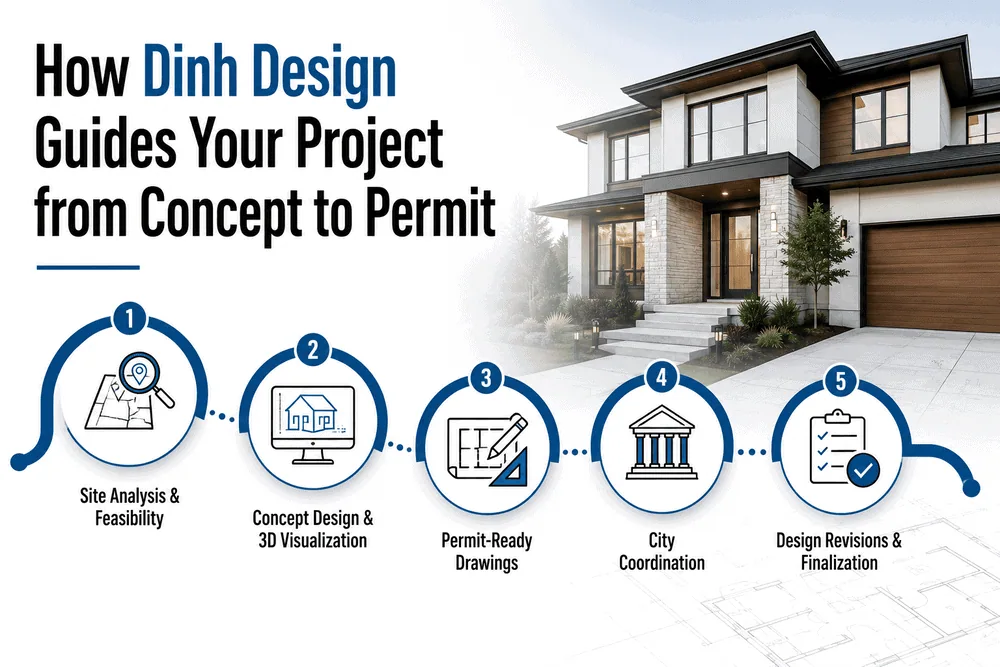
We’re an architectural design and building permit firm based in Mississauga, not a construction company — which means our job is the part of this process that determines whether your timeline and budget hold up: the drawings, the zoning analysis, and the permit submission itself.
That work includes:
- Site analysis and feasibility — checking zoning, setbacks, height limits, and ARU potential before any design work starts, so surprises get caught early instead of after drawings are submitted.
- Concept design with 3D visualization — typically two to three directions to choose from, so you’re comparing real options rather than guessing from floor plans alone.
- Permit-ready drawings — prepared to the standard Mississauga’s building department expects, which is what keeps reviews from bouncing back with corrections.
- Direct coordination with city examiners — we manage the submission and the back-and-forth on clarifications, rather than leaving that to you.
- Unlimited design revisions during the agreed design rounds, so the plan keeps evolving until it’s actually right.
If your project involves a teardown-rebuild in an established neighbourhood, a legal basement second unit, or a laneway suite alongside the main build, those each carry their own zoning and permit considerations — which is generally easier to plan for upfront than to fix mid-design.
Frequently Asked Questions About Custom Home Building in Canada
Not necessarily once you account for total cost of ownership. Resale homes often carry near-term costs that aren't visible at purchase — an aging roof, outdated electrical, or a furnace near end of life. Custom builds have a clearer per-square-foot cost upfront (roughly $400/sq ft for standard builds, $1,000+ for luxury, as of 2026), and because the systems are new, maintenance costs tend to stay low for the first several years.
Plan on roughly 8 to 16 weeks from initial consultation to permit-ready drawings, plus city permit review time, which can range from a couple of weeks to a few months depending on project scope. If your lot needs a Committee of Adjustment variance, add 4 to 10 weeks for that step. Construction time is separate and depends on the builder and scope.
Balance personalization with flexibility. A home office that could convert to a bedroom, or a layout that doesn't depend on highly unusual room placements, keeps the home appealing to future buyers without forcing you to compromise on how you live now.
Yes — this is one of the more common paths homeowners take in established urban and suburban areas, where land value is high but existing housing stock is older. It usually means a teardown-rebuild, which comes with its own zoning review, so it's worth confirming setbacks and height restrictions before you commit to a lot.
Most overruns trace back to decisions made too late — material selections or layout changes after drawings are already submitted. Locking in your design and specifications before submission, and working with a team that handles both the design and the permit coordination, keeps change orders and delays to a minimum.
Ready to Start Designing?
A custom home starts with a clear set of drawings and a realistic path through your local permit process. If you’re ready to talk through your lot, your budget range, and what’s possible, book a free consultation with Dinh Design and we’ll map out the next steps.